


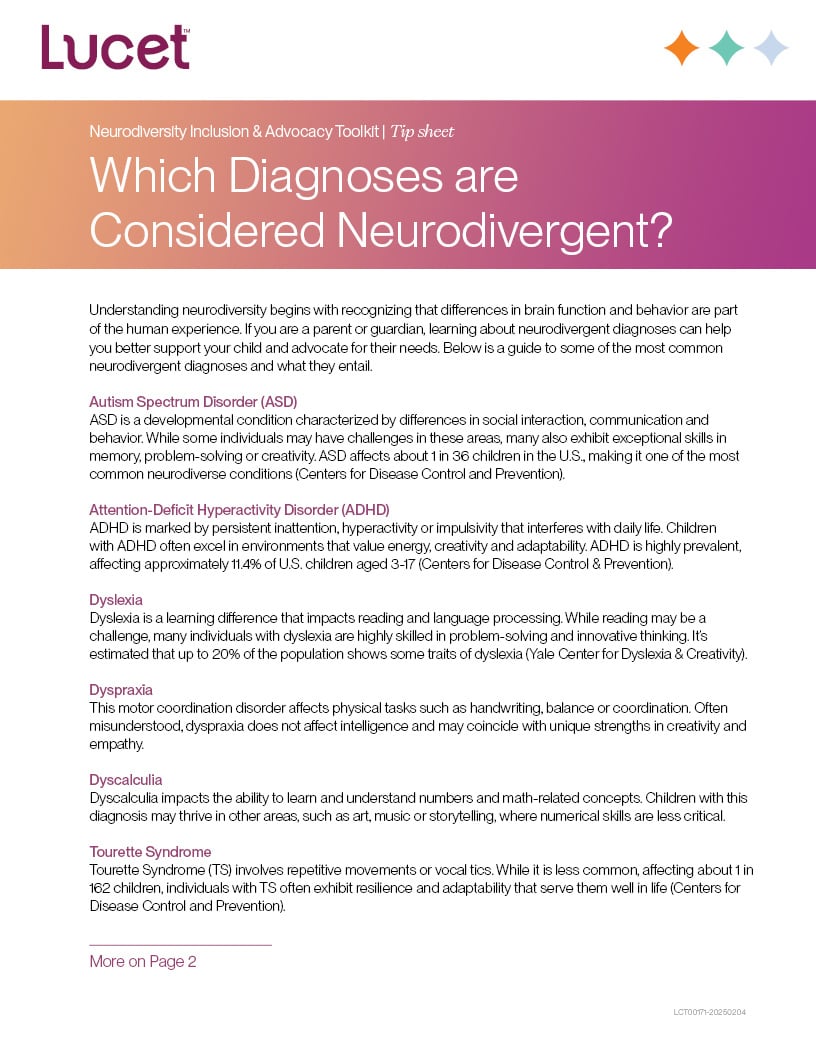
Which Diagnoses are Considered Neurodivergent?
Neurodiversity means people think, learn and act in different ways. These differences are normal. If you are a parent or guardian, learning about them can help you support your child. It can also help you speak up for what they need. Below is a short guide to common neurodivergent conditions.
Autism spectrum disorder (ASD) is one of the most common neurodiverse conditions that affects how someone connects with others (Centers for Disease Control and Prevention). It can also affect how they communicate or behave. Some people with ASD may find social time or changes in routine hard. Many have strong skills in memory, problem solving or creativity.
Attention-deficit hyperactivity disorder (ADHD) affects focus, activity level and self-control. A child with ADHD may have trouble paying attention or sitting still. Many children with ADHD do well in active places. They may be creative, energetic and quick thinkers. ADHD affects over 11% of U.S. children (Centers for Disease Control and Prevention).
Dyslexia is a learning difference that affects reading and language. A child with dyslexia may read slowly or mix up sounds. Still, many children with dyslexia are great problem solvers and think in creative ways. Up to 20% of the population shows signs of dyslexia (Yale Center for Dyslexia and Creativity).
Dyspraxia affects movement and coordination. Tasks like writing, tying shoes or balancing may be hard. Dyspraxia does not affect intelligence. Many children with dyspraxia show strong creativity and empathy.
Dyscalculia affects how a child understands numbers and math. They may struggle with counting or math facts. Many children with dyscalculia shine in art, music, stories or other creative areas.
Tourette syndrome (TS) is less common and causes repeated movements or sounds called tics (Centers for Disease Control and Prevention). These tics can be small or more noticeable. Children with TS often build strong coping skills and show a lot of determination.
There are other conditions too, such as nonverbal learning disabilities and auditory processing disorders. Each one has its own challenges and strengths. Neurodivergent conditions are not problems to fix. They are simply different ways of thinking and learning. When you understand your child’s needs and strengths, you can help them grow and feel confident.
#NeurodiversityChampions #WhatsStrongWithYou
If you or a loved one is curious about neurodiversity or may be neurodiverse, visit Neurodiversity Education Academy for more resources.